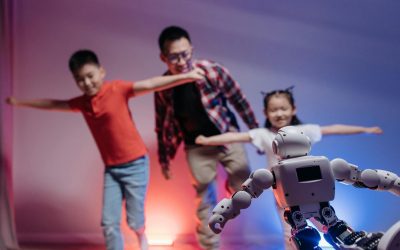

Will your child’s future career be automated? It is a question more parents are starting to ask, and they are right to ask it. The answer is nuanced, but it is not hopeless. Understanding what automation does well, what it cannot do, and what capabilities genuinely protect a career is the most useful thing a parent can know right now.
Automation Is Already Here
Artificial intelligence and automation are not a future threat. They are already reshaping industries across the world. Financial trading is now dominated by algorithmic systems. Medical imaging AI outperforms experienced radiologists on certain diagnostic tasks. Legal document review that once took teams of lawyers weeks now takes AI hours. Customer service, logistics, and manufacturing have all been substantially transformed.
The pace of this change is accelerating, not slowing. By the time your primary school child enters the workforce in 2035 to 2040, the landscape will look considerably different again.
This is not a reason for panic. It is a reason to be deliberate about what you build in your child right now.
What Automation Does Well
To understand which careers are most at risk, it helps to be precise about what AI actually does well. Automation excels at tasks that are repetitive and rule-based, that involve processing large volumes of structured information, that require consistency and speed over judgment and nuance, and that operate within predictable, well-defined parameters.
This is why roles in data entry, basic accounting, routine legal work, standard manufacturing, logistics coordination, and scripted customer service are all under pressure. These roles are not going to disappear overnight, but the number of humans required to perform them will decrease significantly over the coming decade.
What Automation Cannot Do
The limits of automation are as important as its capabilities. AI cannot exercise genuine judgment in truly ambiguous situations. It cannot form authentic human connections. It cannot produce original creative ideas that did not exist in any form in its training data. It cannot navigate genuinely unpredictable physical environments with human dexterity. And it cannot take real ethical responsibility for outcomes.
These limits are not small gaps. They represent the core of what makes human contribution irreplaceable in a wide range of careers.
The roles most resilient to automation are those built around exactly these capabilities: genuine judgment, human connection, original creativity, physical adaptability, and ethical responsibility.
The Careers Most Likely to Grow
As automation handles more routine work, certain categories of human contribution become more valuable, not less. Healthcare roles built around direct patient relationships. Education and counselling where the human connection is the product. Creative leadership and original design. Complex management and strategic decision-making. Skilled trades requiring adaptive physical work across unpredictable environments. Community and social work.
There is also a growing category of roles that did not exist a decade ago: AI oversight, ethics, and governance. As AI systems become more powerful and more embedded in critical decisions, the humans who can navigate the intersection of technical capability and human values will be in high demand.
What This Means for Your Child Right Now
The specific career your child eventually chooses matters less than the foundational capabilities they develop. A child who builds genuine critical thinking, creativity, emotional intelligence, and adaptability is positioned to contribute real human value in whatever role they hold, even as AI reshapes that field around them.
A child trained only to follow instructions and process information, without developing the distinctively human capabilities, is more vulnerable to displacement regardless of which career they pursue.
The good news is that these capabilities are buildable. They develop through experience, through the quality of the environment you create, and through the habits you help your child form. Most of it happens at home, not at school.
Five Things to Build in Your Child Before They Enter the Workforce
Critical and logical thinking. The ability to question assumptions, evaluate evidence carefully, and reason through problems that have no obvious answer. Ask your child open questions that require genuine reasoning rather than recall. Reward good thinking, not just right answers.
Genuine creativity. Not just artistic expression, but the capacity for original problem-solving and the ability to make connections nobody has made before. Protect unstructured time. Boredom is where creativity begins. Resist filling every moment with screens or scheduled activities.
Emotional intelligence. The ability to read other people accurately, regulate their own emotions, and form authentic relationships. Talk about emotions directly and help your child develop precise emotional vocabulary. Give them real experience of taking responsibility for how their actions affect other people.
Adaptability and continuous learning. The capacity to pick up new capabilities when circumstances demand it. Model continuous learning yourself. Show your child that learning does not end when formal schooling does. Help them become comfortable with not-yet-knowing.
The ability to manage and work alongside technology. Not passive consumption, but active and intentional use. A child who understands how AI tools work, who can evaluate what they produce critically, and who can use them to amplify their own human capabilities, is not threatened by automation. They are equipped to use it.
Frequently Asked Questions
Will my child’s specific career interest be automated?
The honest answer is that the career they choose now may look quite different by the time they enter it. Rather than trying to predict specific career futures, focus on building the foundational human capabilities that translate across careers. A child with strong critical thinking, creativity, and emotional intelligence will find their way to contributing genuine value in whatever the labour market looks like in 2040.
Should I be worried about this?
Concerned enough to act, but not paralysed. The parents who will give their children the greatest advantage are those who understand what actually matters and invest in building it consistently over the primary school years. That is what this site is here to help with.
My child’s school seems to be doing well. Is that enough?
Schools do valuable work, but most curricula were not designed for the AI era. The foundational human capabilities that matter most for the future are not the primary focus of standardised testing and content delivery. The gap falls to parents to fill, and it is a gap worth filling deliberately.
Where to Start
The complete guide to building the capabilities that matter most: How to Future-Proof Your Child: The Complete Guide for Parents
For personalised guidance based on your specific child, talk to Cleo. Talk to Cleo free
Related reading: