
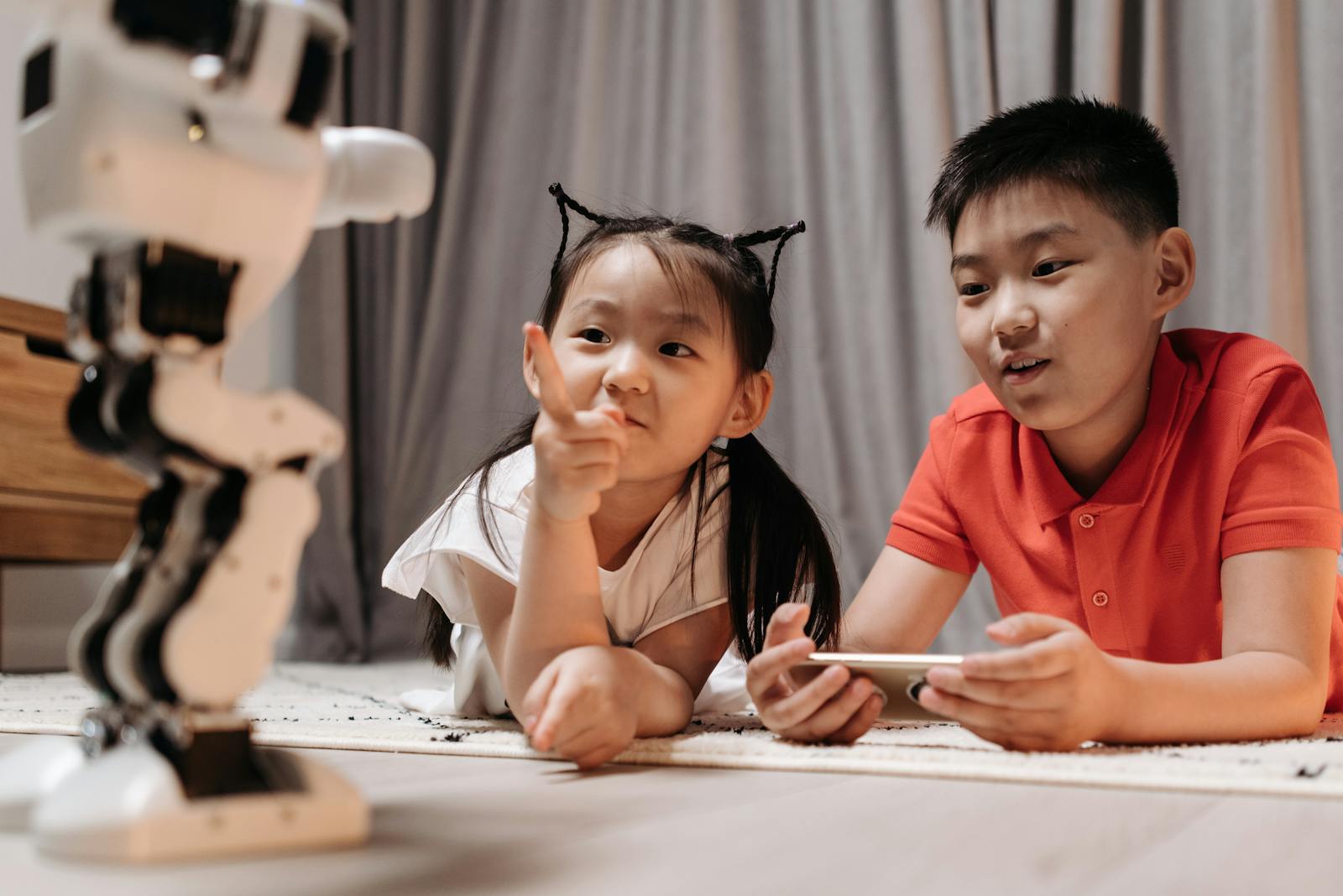
AI and Kids’ Future Careers: What It Actually Means
Parents of primary school children are understandably uncertain about what the AI revolution means for their child’s future. Will there be jobs? What kind? Should they be preparing differently? Here is an honest, grounded answer to those questions — without pretending anyone has the full picture.
The Honest Uncertainty
Nobody can predict with confidence what the job market will look like in fifteen to twenty years. The pace of AI development means that predictions made even five years ago have already been overtaken. What we can say is that change will be significant, that some roles will be automated, and that new roles — that do not currently exist — will emerge.
Preparing children for specific jobs in this environment is a poor strategy. Preparing them to be adaptable, capable learners who can navigate change is a much better one. It is also worth saying that uncertainty has always been part of parenting — just less obviously than it is now. Every generation of parents has raised children into an economy they could not fully predict. The tools shift. The core task does not.
What AI Does Well and What It Does Not
AI is extremely good at pattern recognition, information retrieval, language generation, and repetitive cognitive tasks. It is much less capable of genuine judgment in novel situations, authentic human connection, ethical reasoning in complex contexts, and creative originality.
The roles that are most resistant to automation are those that combine genuine human judgment with interpersonal skill — healthcare, education, law, leadership, counselling, complex problem-solving — and those that require genuine creativity and original thought. The safer bet over time has been to develop the capacities that overlap with these roles, whatever specific industry your child ends up in.
Do Not Over-Specify Their Direction
One of the least useful things a parent can do in this environment is lock a child into a specific future career path at age ten. “You should become a coder” or “you should be a doctor” may seem like future-proofing — but the specific shape of any of these roles in twenty years is unclear. A child pushed down a narrow path may find that path does not exist by the time they reach it.
The better approach is to expose them broadly, help them develop the underlying capabilities that transfer, and let their specific direction emerge from their actual interests and aptitudes over time. Breadth first, depth later.
Generalists May Matter Again
One of the emerging patterns in an AI-rich economy is that generalists — people who can connect ideas across domains, who understand multiple disciplines, who can integrate different perspectives — are increasingly valuable. AI handles narrow expertise well. Integrating across that expertise is much harder for AI and much easier for a human with broad exposure.
This is good news for parents because it means you do not need to make your child hyper-specialise early. A child who reads widely, has varied interests, and is comfortable moving between different kinds of thinking is being prepared well for this environment — possibly better than a child who has been steered toward one deep specialism from age six.
What This Means for Raising Children Now
The capacities that serve children best in an AI-transformed economy are the same ones that have always distinguished effective people: the ability to think clearly, to communicate well, to work with others, to keep learning, to exercise good judgment, and to create genuine value. These are built through the approaches described throughout this cluster.
Technical fluency matters too — understanding how digital systems work, how to use technology purposefully, and how to evaluate AI-generated information. But technical fluency alone, without the human capacities that AI cannot replicate, is less protection than most parents hope. The coder who cannot communicate is less valuable than the thinker who can code enough to use AI tools well.
The Role of Genuine Interests
A child who has developed a genuine interest in something — and the experience of going deep on it — has built a capability that transfers to whatever direction their career eventually goes. The content of the interest matters less than the experience of having pursued it.
Protect that, especially as school gets busier and pressure to optimise their time increases. The child who is allowed to spend hours learning everything about trains, or drawing, or rocks, or a particular video game is developing the capacity to go deep — which is one of the rarer and more valuable capacities in a distracted economy. That capacity transfers. The trains may not be their eventual career, but the orientation will serve them regardless.
What Actually Will Not Change
Amid all the uncertainty, a few things about being a capable adult have not really changed in centuries and are unlikely to change in the next twenty years. Being able to think for yourself. Being able to hold a conversation. Being trustworthy. Being willing to do hard things. Being able to learn new material quickly. Being kind. Being resilient.
If you focus on these things — the slow, boring, durable qualities — you are doing more future-proofing than any specific skill training can provide. The world’s tools will change. The value of a person who is clear-headed, adaptable, and good to work with will not.
Beware of Extreme Predictions on Both Sides
The conversation about AI and the future of work tends to split into two camps: one that says everything is about to be automated and there will be no jobs, and one that says it will all be fine and we should not worry. Neither of these is useful. The likely reality is somewhere in between, messier, and specific to industries and roles in ways that are hard to predict from the outside.
A calmer, more honest stance is to accept that significant change is coming, that the shape of it is unclear, and that the right response is to build adaptable, capable people rather than to bet on any single prediction. Children raised in households that engage with the uncertainty calmly — rather than oscillating between panic and dismissal — absorb the same calm in their own thinking. That alone is a real advantage.
Watch for the Trap of Anxious Preparation
One of the more common patterns among well-meaning parents right now is anxious over-preparation — enrolling children in multiple coding programs, pushing them toward STEM, backfilling them with AI-readiness content, treating every spare moment as a chance to build a future-resistant skill. This often does more harm than good. Anxious children do not learn well. Over-scheduled children do not develop the unstructured interests that turn into genuine capabilities.
The calmer alternative is to trust the boring stuff — reading widely, conversation at meals, unstructured time, depth of engagement with whatever the child genuinely cares about, room to fail and recover. That kind of environment produces a capable, adaptable adult more reliably than any specific curriculum designed to out-guess the future.
The Most Important Thing You Can Do
Raise a child who loves learning and is not afraid to begin again. The specific knowledge they acquire in primary school and secondary school matters less than whether they have developed the orientation, the habits, and the resilience to keep learning throughout their lives. That capacity is more future-proof than any specific skill set.
Adults who continue learning — who pick up new tools, new domains, new ideas as their careers evolve — outperform adults who peaked at the end of their formal education. Build that orientation in childhood, and the specific knowledge will follow as it is needed.
Your Practical Takeaway
Rather than worrying about which specific skills to develop, focus on the meta-question: is your child becoming a confident, curious, persistent learner who is comfortable with uncertainty? That orientation will serve them regardless of what the specific demands of their adult world turn out to be.
For personalised guidance on raising a future-ready child, try Cleo free at lifereadyparenting.com/ask-cleo.