Boredom is one of the most important developmental experiences in childhood. It is also one of the first things to disappear when children have unlimited access to a screen. The result is a generation of kids who can no longer sit with the small, productive discomfort that boredom provides. Reclaiming boredom is one of the most overlooked moves a parent can make.
What boredom actually does for a child
Boredom is not the absence of activity. It is the presence of unstructured time with no immediate stimulation. In that uncomfortable space, a child’s brain does work that nothing else can do.
Boredom drives creativity. A bored child invents a game, builds something out of nothing, asks a strange question, or makes up a story. The discomfort of having nothing to do forces them to generate something internal. This is the muscle that becomes adult creativity.
Boredom builds resourcefulness. A child who has never been bored does not know how to entertain themselves. A child who has been bored a thousand times has learned a thousand different ways to find their own way out of it. That internal resourcefulness is one of the most important traits an adult can have.
Boredom develops attention. Sitting with one’s own thoughts is hard. Children who do it regularly build the capacity for sustained focus. Children who never do it lose that capacity over time.
Boredom creates space for emotional processing. Big feelings need somewhere to go. A child sitting quietly in the back garden with nothing to do is processing whatever happened at school that day, even if neither of you can see it.
Why screens removed boredom
Modern children almost never have to be bored. The waiting time that used to fill life is now filled with content.
- The five minutes in a queue at the supermarket. Phone.
- The car ride home from school. Tablet.
- The half hour before dinner is ready. Television or gaming console.
- Sunday afternoon. YouTube.
- The 20 minutes before falling asleep. Phone again.
Each of these used to be a moment where the child had nothing to do. The moments are not gone. They have been filled. And the developmental work that used to happen in them has stopped.
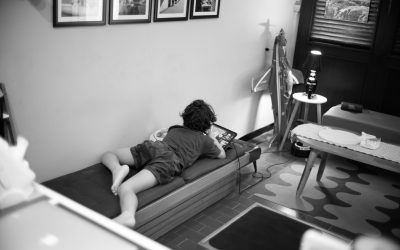
Most parents do not realise this is happening because the child looks calm. They are not running around the house, not asking for things, not bothering anyone. The calm of a child on a screen looks like good parenting. It is actually the absence of the productive discomfort their development needs.
What it looks like when a child has not been bored
A child who is never bored cannot tolerate the early stages of a difficult task. School work that requires focus. A book that takes a few pages to get going. A new skill that requires repetition before it gets satisfying. All of these require the capacity to sit with low stimulation. A child without that capacity gives up at the first moment of friction.
A child who is never bored cannot generate their own activity. Asked what they want to do, they say they do not know, then ask for the screen. Without external stimulation, they feel adrift. The internal world that should fill that space has not been built.
A child who is never bored is often more anxious. Boredom forces a child to sit with their own thoughts, including the uncomfortable ones. Over time, this builds tolerance for being alone with one’s own mind. Children who have never had to do this often find their own thoughts unsettling, and reach for the screen to escape them.
How to reintroduce boredom
Reintroducing boredom is not about removing all screens. It is about protecting some of the in-between moments where boredom used to happen naturally.
Choose one moment a day where boredom is allowed
The car ride. The 30 minutes before dinner. Sunday morning before lunch. Pick one moment that recurs and make it screen-free. Do not fill it with an alternative activity. Let the moment itself be empty.
Resist the urge to rescue
The first few times your child is genuinely bored, they will tell you. They will say “I’m bored” with the expectation that you will fix it. The most important thing you can do in that moment is not fix it.
Say something like: “I know. Boredom is fine. You’ll figure something out.” Then leave them with it.
The first few times this happens, your child will whine, complain, or demand a screen. By the fourth or fifth time, they will start to look around the room. By the tenth or fifteenth, they will start finding things on their own. The muscle is being rebuilt.
Notice what they do
What a child reaches for when they are genuinely bored tells you a lot about who they are. They might pick up a book. They might draw. They might go outside. They might invent a strange game in the back garden. None of these will happen if a screen is the easier option. All of them will start happening within two or three weeks of protected screen-free time.
What changes
Parents who reintroduce regular boredom typically notice three things within a month.
Their child becomes more independent. The constant requests for entertainment ease off. The child starts being able to find their own thing to do.
Their child becomes more interesting. The internal world that has been crowded out by content starts to reappear. Strange questions, unexpected interests, surprising opinions, all the things that make a child specifically who they are.
The household calms down. A child who can entertain themselves for half an hour is a child whose parents can have a coffee, a conversation, or a quiet moment of their own. Boredom is good for everyone.
The bigger picture of why this work matters is in the Let’s Get Them Back manifesto. The full set of tools sits in the Complete Guide to Screen Time.
Frequently Asked Questions
Why is boredom good for my child?
Boredom drives creativity, builds resourcefulness, develops attention, and creates space for emotional processing. The discomfort of having nothing to do is what forces a child to generate their own internal world.
What should I say when my child says they are bored?
Say “I know. Boredom is fine. You’ll figure something out.” Then leave them with it. Do not rescue. The first few times will be uncomfortable. By the fifth or sixth time, the child will start finding things on their own.
How much boredom is enough?
Most children benefit from at least one screen-free, unstructured moment per day. Thirty minutes to an hour. The car ride or the time before dinner are good options.
Will my child be unhappy if they are bored?
Briefly, yes. The early discomfort is the point. By the second or third week of regular boredom, children stop complaining and start using the time. The unhappiness gives way to creativity, not the other way around.
Is screen time the same as boredom prevention?
No. Screens are stimulation, not boredom. A child who is on a screen for two hours has not been bored for two hours. They have been receiving constant input. The brain treats this very differently from genuine unstructured time.
What if my child genuinely cannot find anything to do?
This is normal at the start. The capacity to entertain oneself is a muscle that has weakened. It rebuilds quickly. Three to four weeks of protected boredom and the muscle is largely back. Patience matters.