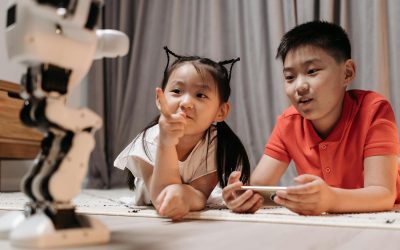
What does it mean to raise a child who is truly irreplaceable? Not in the sense of being impossible to fire, but in the deeper sense of being someone who consistently creates value that machines cannot replicate and that other people cannot easily substitute.
This is the most useful frame a parent can have right now. Not what career will my child have, but what kind of person will they be. The future skills that make children genuinely irreplaceable are consistent across serious research, and they are buildable during the primary school years.
Why Irreplaceability Is the Right Goal
In an economy where AI is handling more of the routine cognitive work and automation is displacing more of the predictable physical work, the people who thrive are those who consistently contribute something that genuinely could not be produced as well by a machine or easily copied from another person.
That kind of irreplaceability is not about being the best in the world at a specific technical skill. It is about being distinctively human in ways that matter. It is about bringing genuine judgment to ambiguous situations. It is about forming authentic relationships. It is about thinking in ways that produce original outcomes. And it is about continuing to develop and adapt across an entire working life.
None of these are things that happen by accident. They are built deliberately, through childhood, through the quality of the environment parents create.
The Six Future Skills That Make Children Genuinely Irreplaceable
Critical thinking and logical reasoning. The ability to evaluate information carefully, question assumptions, identify logical errors, and reason clearly through problems with no obvious answer. This is the foundational skill that makes all the others more powerful. A child who thinks clearly learns faster, adapts more readily, and makes better decisions across every area of life. It is built through the habit of being asked to reason, through open questions, through real problems that require genuine thinking.
Genuine creativity and original problem-solving. Not artistic expression alone, but the capacity to make connections that nobody has made before, to approach familiar problems from angles that produce genuinely new outcomes. As AI floods the world with competent derivative output, genuine originality becomes more scarce and more valuable. It is built through unstructured time, through making things, through the freedom to experiment and fail.
Emotional intelligence and authentic human connection. The ability to read other people accurately, regulate one’s own emotional responses, and form relationships of genuine trust. The careers most immune to automation are those where the human relationship is the product. This capability is built through real social experience, through conversations about emotion, and through the modelling that parents provide in their own relationships.
Adaptability and the capacity to keep learning. The meta-skill that makes all the others sustainable across a working life that will require multiple cycles of reskilling. A child who has developed genuine adaptability is not threatened by change. They find it navigable. It is built by modelling continuous learning, by exposing children to varied experiences, and by creating an environment where curiosity is valued and not-yet-knowing is treated as a temporary state rather than a failing.
Complex judgment in ambiguous situations. The ability to make good decisions when the rules are unclear, when multiple values are in tension, when the right answer requires genuine ethical reasoning alongside technical analysis. This is what remains distinctively human in high-stakes professional contexts and it is what AI is furthest from being able to replicate.
The ability to create value independently. Understanding how to identify what is needed and produce it, without waiting for instructions. This entrepreneurial orientation, the habit of seeing problems as opportunities and taking initiative to address them, will be increasingly valuable in a workforce where more people work for themselves or in fluid project-based arrangements. It is built through real experience of identifying and solving real problems, from household decisions to community projects.
Building These Skills at Home
The most important thing to understand is that these capabilities are primarily built through the quality of daily life at home, not through structured programs or scheduled activities.
Ask better questions at dinner. Let your child struggle with things within their capacity. Protect genuinely unstructured time. Talk about what you are learning and figuring out. Have direct conversations about emotions. Let them manage real money and make real decisions. Read together. Encourage genuine depth in things they are passionate about, even if those things seem impractical.
None of this is complicated. Most of it is free. All of it is within your reach as a parent, regardless of your resources or circumstances.
Frequently Asked Questions
Is it too late if my child is already in upper primary school?
No. These capabilities continue developing through adolescence and into adulthood. The primary school years are particularly valuable because the habits and orientations formed then tend to persist, but starting now at whatever age your child is will produce meaningful results.
My child seems resistant to learning. What do I do?
Resistance to formal learning is often resistance to the way learning is being presented, not to learning itself. Most children are naturally curious about things that genuinely interest them. Follow that genuine interest wherever it leads, even if it seems impractical, and use it as the entry point for building the broader capabilities. Passion and genuine engagement are the most powerful learning accelerators available.
The Complete Guide
For the full picture: How to Future-Proof Your Child: The Complete Guide for Parents
Talk to Cleo for personalised guidance. Talk to Cleo free
Related reading: